Why Should You Even Care About SIEM?
Here's the thing — every org I've worked with generates an absurd amount of logs. Firewalls, servers, endpoints, cloud stuff, SaaS apps... it's a firehose. And most of the time? Nobody's actually looking at it. Not really.
That's the problem SIEM is supposed to solve. When your firewall blocks something sketchy at 3 AM and your Active Directory shows a weird login at 3:02 AM from the same subnet — those two events mean nothing in isolation. A SIEM connects them. Without that correlation, you're basically hoping someone notices before it's too late.
IBM's breach reports keep saying the same thing year after year: orgs that take forever to detect breaches pay way more. It's not exactly groundbreaking insight, but it reinforces why visibility matters. If you can't see what's happening across your environment, the CIA triad isn't a framework — it's a wish list.
So What Actually Is a SIEM?
Security Information and Event Management. Gartner coined the term back in 2005 by mashing together two older concepts: SIM (Security Information Management — basically log storage and reporting) and SEM (Security Event Management — real-time monitoring and alerting). The marriage made sense. You need the memory and the reflexes.
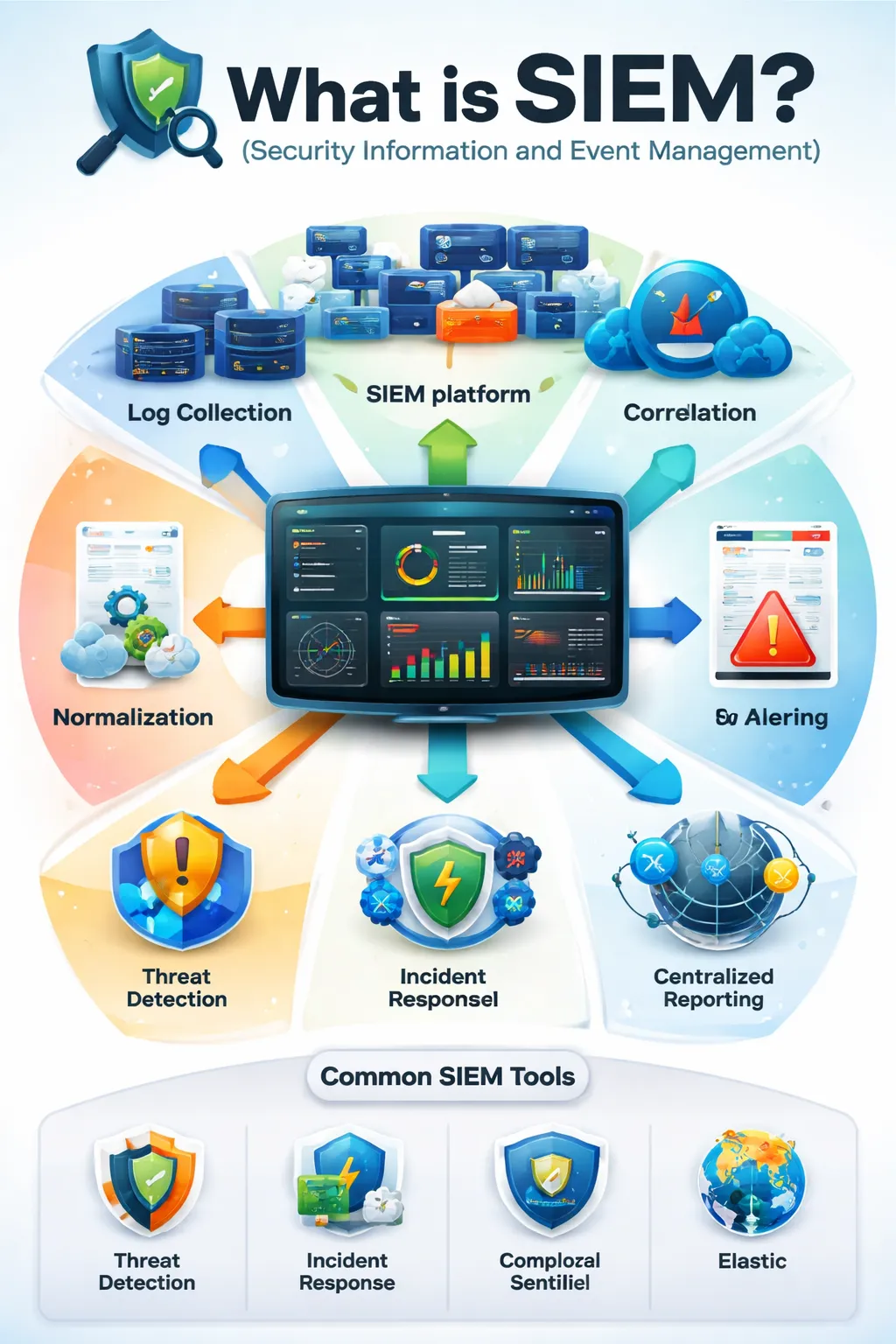
In practice, a SIEM ingests logs from across your environment, normalizes them into a common format, runs correlation rules and analytics against them, and spits out alerts when something looks wrong. It also stores everything so you can go back and investigate after the fact.
That's the elevator pitch, anyway. Modern SIEMs have bolted on a lot more — UEBA (User and Entity Behavior Analytics), threat intel feed integration, SOAR playbooks. Some have gotten so feature-bloated they're practically their own ecosystems. Whether that's a good thing depends on your team's maturity and budget.
What's Under the Hood
Understanding the architecture matters more than most people think. I've seen teams buy a SIEM and then wonder why their detections are garbage — usually it's because they skipped the boring foundational stuff.
Log sources are your raw material. Firewalls, IDS/IPS, EDR agents, DNS servers, VPN concentrators, cloud audit logs (CloudTrail, Azure Activity Logs, GCP Audit Logs), SaaS platforms like M365 or Google Workspace. The more diverse your sources, the better your coverage. But there's a tradeoff — every new source costs money to ingest and effort to parse.
Collection happens via syslog, agents, or API-based collectors. Quick note: syslog over UDP drops packets. I've seen orgs lose critical auth logs because they cheap'd out on TCP/TLS transport. Don't be that team.
Parsing and normalization is where the magic (and the pain) lives. A Windows Event ID 4625 looks nothing like a Linux auth.log failed login or a Palo Alto deny log. The SIEM has to parse each format and map fields — source IP, destination, username, action, timestamp — into a common schema. Get this wrong and your correlation rules won't fire, even when the attack is staring you in the face.
Then there's enrichment. GeoIP lookups on source addresses, threat intel matching against known bad indicators, asset context so you know whether that server is a dev box or your payment processing system. Enrichment is what turns a log line into something an analyst can actually make decisions on.
The correlation engine is the brain. One failed login? Who cares. Fifty failed logins from the same IP hitting ten different accounts in two minutes? That's a brute-force attack, and the correlation engine connects those dots. Rules can be simple threshold-based stuff or genuinely complex multi-stage logic.
Storage gets expensive fast. Most shops do tiered storage — hot for recent data (fast queries), warm for a few months back, cold/archive for the compliance-mandated multi-year retention. Get your retention policy wrong and you'll either blow your budget or fail an audit. Pick your poison.
A Real-ish Detection Scenario
Theory's great. Let me walk you through something closer to reality.
Say you've got a service account — SVC-BACKUP — that runs automated backups on Server-A every night at 1 AM. It's been doing this for two years. Boring, predictable, exactly how service accounts should behave.
Then one Tuesday at 2 PM, that same account authenticates to your VPN. From an IP that geolocates to a country where you have zero operations. The SIEM flags the anomaly because the account has never touched the VPN before, and definitely not during business hours from Eastern Europe.
Minutes later, the correlated view shows that same session making AWS API calls — enumerating S3 buckets, attempting downloads from one tagged as containing PII. The source IP? Cross-referenced against threat intel, it's a known Tor exit node.
Without the SIEM, here's what happens: the VPN team might notice a weird login in their logs. The cloud team might see unusual S3 access. But nobody connects them. The attacker gets their data and you find out three weeks later from a journalist or a regulatory body.
With the SIEM, a high-severity alert fires within minutes. The analyst gets a full timeline, pivots across data sources, and the incident response process kicks off while the attacker is still fumbling around. That's the difference.
Detection Isn't One-Size-Fits-All
Something that bugs me about a lot of SIEM content online — they talk about "detection" like it's a single thing. It's not. There are fundamentally different approaches, and each has blind spots.
Rule-based detection is your bread and butter. "If X happens Y times in Z minutes, alert." Great for known attack patterns. Terrible for anything novel. You're essentially writing signatures for attacker behavior, which means you're always one step behind.
Behavioral baselines are more interesting. The SIEM learns what "normal" looks like for each user, device, or service over time, then flags deviations. This is how you catch insider threats and lateral movement — patterns that don't match any predefined rule but are clearly abnormal. The catch? Noisy baselines during onboarding periods, org changes, or migration projects. Expect to babysit these for a while.
Threat intel matching is dead simple — compare your traffic against lists of known bad IPs, domains, and file hashes. Low false-positive rate for known threats, completely useless against anything new. It's table stakes, not a strategy.
UEBA (User and Entity Behavior Analytics) layers machine learning on top of behavioral analysis. Sounds fancy, and honestly, when it works, it's impressive. I've seen it catch compromised credentials that rule-based detection completely missed. But it needs months of clean data to build good models, and the "ML" label makes people trust it more than they should.
The right answer is all of the above, layered. No single detection method covers everything. If someone tells you otherwise, they're selling something.
Where SIEM Sits in the Controls Framework
For the CISSP crowd — and honestly, for anyone building a security program — it helps to think about SIEM through the lens of security controls.
It's primarily a detective control. That's its job. It watches, correlates, and tells you when something's off. But it bleeds into other categories too. The insights from SIEM drive preventive improvements — tightening firewall rules, revoking compromised creds, patching the vulnerability that attackers keep probing. Some SIEMs now integrate with SOAR to trigger automated responses, which starts looking a lot like an active preventive control.
It's also a corrective control enabler — the faster you detect, the faster you contain. MTTR (mean time to respond) drops significantly when your analysts aren't manually hunting through five different consoles.
And here's one that doesn't get enough attention: SIEM as a compensating control. Got legacy systems you can't patch? (Everyone does.) Heavy monitoring on those assets through SIEM can partially offset the risk. It won't fix the vulnerability, but it'll tell you when someone's exploiting it. Auditors generally accept this if you frame it correctly.
NIST SP 800-137 calls this "continuous monitoring" — maintaining ongoing awareness of your security posture, vulnerabilities, and threats. It's not optional anymore in most compliance frameworks. FedRAMP demands it. Most mature security programs have adopted it regardless of regulatory pressure.
The Compliance Angle
Let's be honest — a lot of SIEM deployments exist because an auditor said they had to. That's not great motivation, but it's reality. Here's what the major frameworks actually require:
PCI-DSS Requirement 10 is basically a love letter to SIEM. Track and monitor all access to network resources and cardholder data, review logs daily, retain audit trails. If you're handling payment card data without centralized log management, you're going to have a bad time during your QSA assessment.
HIPAA wants audit controls over systems with ePHI. It's less prescriptive than PCI about how, which means the bar is lower but also means you can't point to a specific control number when justifying your SIEM budget. Fun.
ISO 27001 Annex A — specifically A.12.4 (Logging and Monitoring) — maps directly to SIEM capabilities. Certification auditors will absolutely ask to see your dashboards, your alert response procedures, and evidence of regular review.
NIST CSF's Detect function (DE.CM for continuous monitoring, DE.AE for anomalies and events) aligns naturally with what a SIEM does. If you're mapping your program to NIST, SIEM covers a significant chunk of the Detect category.
The real value beyond checkbox compliance? When a breach happens — and eventually something will — regulators want to see that you had monitoring in place, detected it in a reasonable timeframe, and can produce logs to reconstruct what happened. A well-maintained SIEM is your evidence of due diligence. Without it, you're arguing "we tried our best" without receipts.
The Tooling Landscape
Quick rundown because everyone always asks "which SIEM should we use?" and the answer is always "it depends."
Splunk is the 800-pound gorilla. SPL (its query language) is genuinely powerful, the ecosystem is massive, and it can do basically anything. The tradeoff? Cost. Splunk licensing at scale makes finance teams cry. If you've got the budget, it's hard to beat. If you don't, it'll eat you alive.
Microsoft Sentinel is the obvious pick if you're already deep in the Azure/M365 ecosystem. Cloud-native, KQL is clean and well-documented, and the SOAR integration via Logic Apps is solid. Less ideal if you're multi-cloud or have significant on-prem infrastructure that doesn't speak Microsoft.
Elastic Security rides on the ELK stack. Open-source roots, incredibly flexible, and cost-effective if you have the engineering talent to deploy and maintain it. Key word: if. I've seen small teams drown trying to run Elastic at scale without dedicated platform engineers.
Wazuh deserves more attention than it gets. Open-source, combines SIEM with XDR and compliance capabilities, and the endpoint monitoring is legitimately good. For orgs that need real capability without licensing costs, it's a compelling option. The community is active and the docs have gotten significantly better.
IBM QRadar has been around forever and has strong correlation capabilities. Popular in banking and government — regulated industries where "nobody gets fired for buying IBM" still applies. The offense-based alert model is genuinely different from other SIEMs in a good way.
Google Chronicle (SecOps) is the newcomer with deep pockets. Built on Google's infrastructure for massive ingestion at predictable cost. The fixed pricing model is attractive if you're drowning in data volume-based licensing from other vendors.
SIEM vs Log Management vs XDR — They're Not the Same Thing
I keep seeing these used interchangeably and it drives me nuts.
Log management collects and stores logs. That's it. You can search them, you can retain them for compliance, but it's not correlating events or generating security alerts. It's a filing cabinet, not a security analyst.
SIEM builds on log management by adding normalization, correlation, detection logic, alerting, and investigation workflows. It turns raw data into security insights. That's the whole point.
XDR (Extended Detection and Response) is the newer kid. It integrates telemetry from endpoints, network, cloud, email, and identity into a tighter, more automated detection and response platform. Think of it as more opinionated and integrated than SIEM, but less flexible. XDR vendors control the data sources and detections more tightly, which means better out-of-box coverage but less ability to ingest arbitrary log sources.
Hot take: most mid-to-large orgs will end up running both. SIEM for broad log aggregation, compliance, and custom detections. XDR for high-fidelity endpoint and identity detections with automated response. They're complementary, not competing — despite what vendor marketing departments want you to believe.
Where SIEMs Fall Short (Honest Version)
I'd be doing you a disservice if I didn't talk about the problems. SIEM marketing makes everything sound seamless. Reality is messier.
Cost is the elephant in the room. Most SIEMs charge based on ingestion volume — events per second or GB per day. As your environment grows, so does your bill. I've watched organizations make genuinely bad security decisions (not ingesting critical log sources) purely because of cost. That's a broken model, and it's one reason Chronicle's flat-rate pricing turned heads.
Alert fatigue is real and it's dangerous. A default-config SIEM with out-of-the-box rules will drown your analysts in noise. I'm talking thousands of alerts per day, most of them garbage. Without aggressive, ongoing tuning — suppressing known false positives, adjusting thresholds, retiring useless rules — your team stops trusting the alerts. And when they stop trusting the alerts, they miss the real ones. This is how breaches happen even with a SIEM in place.
The skills gap is brutal. Writing a decent detection rule for something like Kerberoasting requires understanding Active Directory authentication, Kerberos ticket mechanics, Event ID 4769 with specific encryption type filters, AND the SIEM's query language. That's a lot of intersecting expertise. Good SIEM engineers are rare and expensive, and expecting a junior SOC analyst to build and tune detections is setting everyone up to fail.
Coverage gaps are invisible until they're not. Your SIEM only knows what you feed it. If DNS logs aren't being ingested, DNS tunneling exfiltration is invisible. If you're not collecting PowerShell script block logging, fileless malware flies under the radar. Regular coverage assessments — mapping your log sources against something like the MITRE ATT&CK framework — expose these gaps before attackers do.
Stuff That Actually Helps (Lessons from the Trenches)
Start with use cases, not data sources. I can't stress this enough. Don't just throw every log you can find into the SIEM and hope detections materialize. Start by asking: what do we need to detect? Map those requirements to MITRE ATT&CK techniques. Figure out which data sources you need for those specific detections. Then ingest those. Everything else is noise and cost.
Your high-value log sources are probably: authentication logs (AD, LDAP, SSO), DNS queries, endpoint telemetry (EDR), email gateway logs, and cloud audit trails. These cover a disproportionate number of attack techniques per dollar spent on ingestion.
Tune weekly, not quarterly. Set aside time every week to review alert volumes, identify the noisiest rules, and either fix them or kill them. A rule that generates 500 false positives a day isn't a detection — it's camouflage for attackers.
Every critical alert needs a runbook. When a high-sev alert fires at 2 AM, the on-call analyst shouldn't be guessing what to do. Document the triage steps, investigation queries, escalation criteria, and containment actions. Consistency matters more than brilliance at 2 AM.
Measure something. MTTD (mean time to detect), MTTR (mean time to respond), alert-to-incident ratio, log source coverage percentage. Pick a few metrics and track them. If you can't measure whether your SIEM is making you more secure, you're operating on faith. Faith is not a security strategy.
Wrapping Up
SIEM isn't glamorous. It's not the flashy AI-powered threat-hunting platform that vendors pitch at RSA. At its core, it's plumbing — collecting logs, normalizing data, running rules, generating alerts. But it's critical plumbing. Without it, your security program is reactive at best and blind at worst.
If you're studying for the CISSP, know that SIEM touches multiple domains. It lives in Security Operations (Domain 7) but connects to Security Assessment and Testing (Domain 6) through continuous monitoring, and to Security and Risk Management (Domain 1) through compliance and governance. Exam questions won't just test you on what SIEM does — they'll test whether you understand why it matters across the broader security program.
And if you're a practitioner? The deployment is the easy part. The hard part — the part that actually determines whether your SIEM is worth the money — is the ongoing investment in tuning, staffing, and coverage. An untuned SIEM with default rules and incomplete log coverage is just an expensive log archive with a dashboard nobody trusts.
Don't be that team.