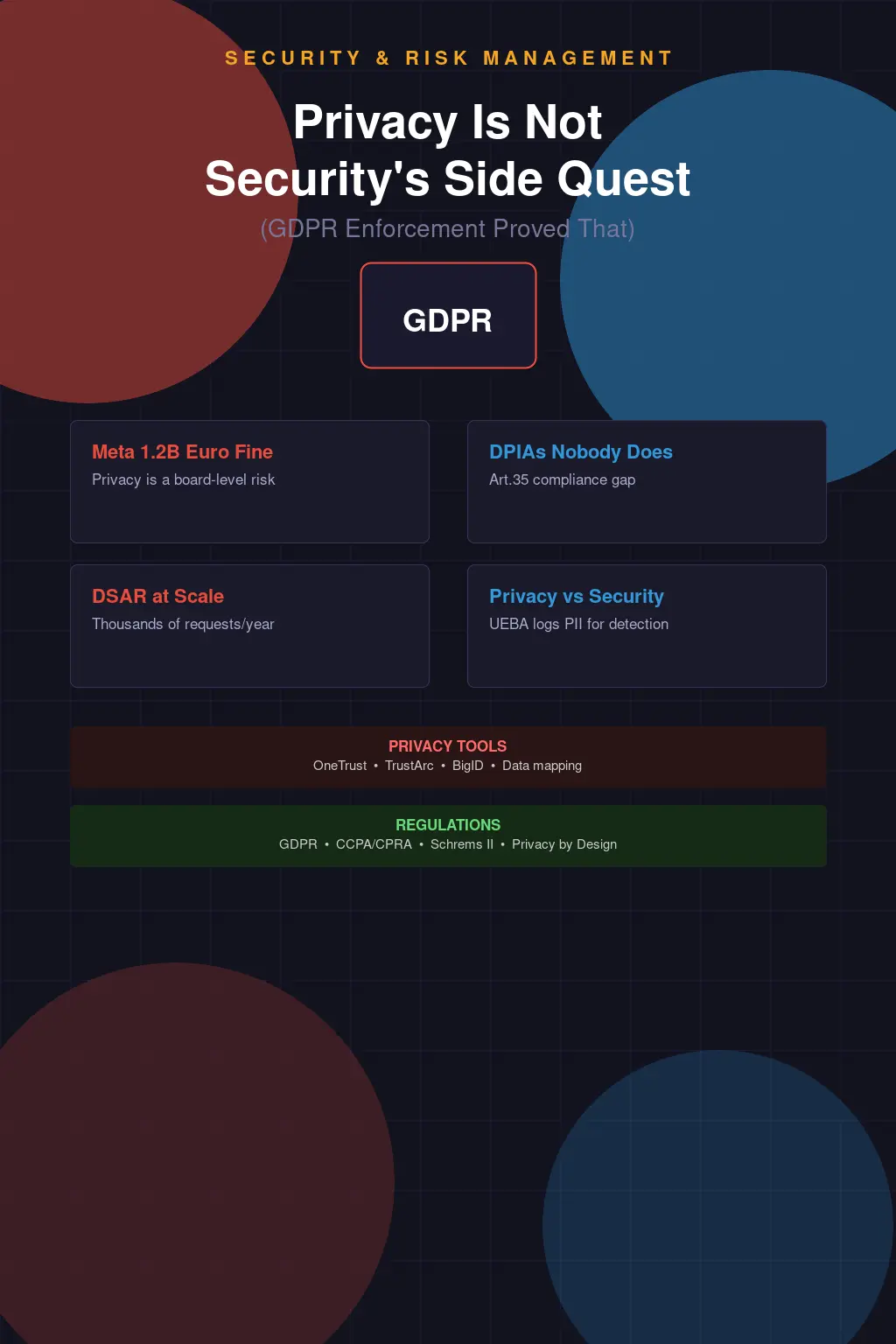
Privacy Is Not Security's Side Quest — GDPR Enforcement Proved That
For a long time, privacy was the thing that legal handled and security occasionally got looped into when someone needed to fill out a vendor questionnaire. The two disciplines shared vocabulary — "data protection," "access controls," "breach notification" — but operated largely in parallel, with privacy focused on policy and legal obligations while security focused on technical controls. That model collapsed slowly and then very quickly once European regulators demonstrated they were actually willing to enforce GDPR with fines that get a board's attention in a way that no security team's slide deck ever managed.
Meta's €1.2 billion fine from the Irish Data Protection Commission in 2023 was a watershed moment not because the underlying violation — transferring EU user data to the US under Standard Contractual Clauses post-Schrems II — was news to anyone who'd been paying attention, but because the scale made it undeniably a business risk rather than a compliance footnote. Amazon's €746 million fine from Luxembourg's data protection authority in 2021. Google's accumulated fines across EU jurisdictions. These aren't warnings. They're structural business costs that flow directly from decisions about how data is collected, processed, stored, and transferred.
If you're a security engineer who's been treating privacy as someone else's problem, these numbers should recalibrate your thinking. Privacy violations increasingly have the same financial consequence profile as major security incidents, and many of the technical controls that prevent one also prevent the other. The disciplines are converging whether the org chart reflects that or not.
Privacy by Design Is an Architectural Commitment, Not a Checkbox
GDPR Article 25 mandates data protection by design and by default. The requirement has been in force since May 2018. The rate of compliance with the actual spirit of it — not the policy attestation, but the architectural implementation — is still embarrassingly low. What Article 25 actually demands is that privacy considerations shape system design from the beginning: that you collect only the data you need, that you default to the most privacy-protective settings, and that the technical architecture enforces these principles rather than relying on runtime policies that can be changed or bypassed.
In practice, what I see is privacy as afterthought. The product ships with analytics that collect everything imaginable because someone said "we might want this data someday." The logging system captures every user action including PII fields because it was easier to log everything than to filter. The data warehouse has customer email addresses in seventeen different tables because they were denormalized for query convenience at some point and nobody cleaned it up. Then, when a Data Subject Access Request comes in and you need to find everywhere a specific user's data lives, you discover you have no inventory, no data map, and no technical capability to do it systematically. Article 25 compliance on paper, Article 25 violation in practice.
Data mapping and inventory aren't glamorous work. Building a comprehensive map of what personal data you collect, where it lives, who processes it, what the legal basis for processing is, and how long it's retained is tedious and requires cooperation across engineering, product, and legal. Most organizations have done a partial version of it — enough to answer a questionnaire — and have never maintained it as the system evolved. The map that was accurate when it was created is wrong within six months of any significant feature development because engineers don't think about updating the data inventory when they add a new field to the user profile table.
DPIAs: The Risk Assessment Nobody Does
Data Protection Impact Assessments are required under GDPR Article 35 for processing activities that are likely to result in high risk to individuals — large-scale processing of sensitive data, systematic monitoring, novel technologies. The threshold is deliberately vague, which means legal teams interpret it differently and many organizations have concluded that their processing activities don't trigger the requirement. That's sometimes a legitimate conclusion and sometimes motivated reasoning.
Even where DPIAs are done, the quality is wildly inconsistent. A DPIA is supposed to be a substantive risk assessment: here's the processing activity, here's the data involved, here are the risks to individuals, here are the mitigating controls, here's the residual risk. What I've seen in practice ranges from genuinely thoughtful documents that change system design decisions to single-page forms that amount to "we considered privacy and decided it was fine." The latter is liability mitigation, not privacy protection. And a regulator who examines it in the context of an enforcement action is going to know the difference.
The DPIA process is actually useful if you run it honestly. Forcing a cross-functional team to sit down and ask "what could go wrong with how we're handling this data, and who gets hurt" before shipping a feature catches real problems. I've seen DPIAs identify that a proposed analytics implementation would create user profiles that would qualify as sensitive data under Article 9, which required either a different technical approach or an explicit legal basis that the team hadn't established. That's the process working. It caught a problem before the feature shipped rather than after an enforcement action.
The Privacy vs. Security Tension Is Real and Unresolved
This is the conversation that makes privacy lawyers and security engineers uncomfortable in the same room. Security monitoring requires data. Good security monitoring requires detailed data — user behavior baselines, access patterns, content inspection for DLP, session recording for insider threat. A lot of that data is personal data under GDPR's broad definition. You're processing it to protect the organization, but you're still processing it, and the individuals whose data you're processing have rights around it that can conflict directly with your monitoring objectives.
User and Entity Behavior Analytics platforms log user activity at a granular level and use it to detect anomalies. That's highly valuable for detecting insider threats and compromised accounts. It's also, depending on your jurisdiction and your workforce agreements, potentially unlawful employee monitoring that requires specific legal bases, potentially works council consultation in German-speaking countries, and must be disclosed to employees in many jurisdictions. I've seen UEBA deployments blocked by European legal teams on exactly these grounds. The security team had a legitimate use case. The legal team had a legitimate concern. Nobody had resolved the tension before the platform was purchased.
The "we're not in the EU so GDPR doesn't apply" misconception persists at a remarkable rate. GDPR's territorial scope, laid out in Article 3, covers processing of personal data of individuals in the EU regardless of where the controller is established — if you're offering goods or services to people in the EU, or monitoring their behavior, GDPR applies. A US-headquartered SaaS company with European customers is subject to GDPR. A US-headquartered company with European employees is subject to GDPR for employee data. The list of companies who've been wrong about this and found out through enforcement action keeps getting longer.
CCPA/CPRA and the Operational Reality
The California Privacy Rights Act took CCPA's foundation and built something significantly more demanding on top of it. The right to correct inaccurate personal information. Sensitive personal information as a distinct category with additional restrictions. Opt-out rights for sharing data, not just selling it. The expansion of enforcement beyond just the AG's office to include a dedicated privacy protection agency. These aren't incremental changes — they represent a meaningful shift in what organizations operating in California have to be able to do technically.
The operational impact of data subject rights at scale is something that catches organizations off guard. Responding to a DSAR (Data Subject Access Request) for a small company with clean data architecture is manageable. Responding to DSARs for a large company with a decade of accumulated technical debt, multiple databases, a data warehouse, a CDN with logs, analytics platforms, email marketing systems, and a CRM is a project. You need to be able to find all data for a given individual, compile it in a portable format, and respond within the statutory window — 45 days under CCPA/CPRA, one calendar month under GDPR. Doing this manually at scale is not viable. It requires technical investment in tooling before you need it, not after you receive a request from a plaintiff's attorney.
Consent management platforms like OneTrust and TrustArc solve a real problem but introduce their own complexity. The consent banner is the visible part. The actual value is in the consent management backend — recording what consent was given, when, under which version of the privacy notice, and ensuring that downstream systems honor that consent. The integration between the CMP and your data infrastructure is where implementations usually break down. Getting the banner right and then continuing to fire analytics tags regardless of consent status isn't compliance — it's the appearance of compliance, which is arguably worse because it suggests awareness of the requirement and deliberate non-implementation.
Cross-Border Transfers After Schrems II
The Court of Justice of the EU's invalidation of Privacy Shield in 2020 left a lot of US-EU data transfers in legal limbo. Standard Contractual Clauses became the primary mechanism for most organizations, and the EU-US Data Privacy Framework that came into force in 2023 has restored some level of adequacy for DPF-certified organizations — for now, pending the legal challenges that are already working through the courts. If you've been in this space for more than five years, you know that the DPF is Privacy Shield 3.0 and the same fundamental tension between US surveillance law and EU privacy rights hasn't been resolved, just temporarily papered over.
For technical practitioners, the Schrems II fallout meant actually examining data flows that had previously been ignored. Where is your Salesforce data stored? Your Workday HR data? Your AWS region? The transfer mechanism for each? These questions used to be purely legal questions. Post-Schrems II, they became architectural questions, because sometimes the answer to "what's our transfer mechanism" is "we don't have one and this transfer shouldn't be happening in the form it currently is." That's a product and engineering decision, not just a legal checkbox.
The Privacy Engineer Role and Why You Need One
The privacy engineer role — the person who sits between legal's requirements and engineering's implementation and knows enough of both languages to translate effectively — is one of the most underinvested roles in the industry. Most organizations have privacy lawyers and general software engineers. What they don't have is someone who understands data flows at a technical level, knows what DPIA requirements look like when translated into system design, can evaluate a proposed analytics architecture for GDPR compliance before it's built rather than after it's shipped, and can help security teams understand where their monitoring programs create privacy obligations.
The closest analog is the security architect role — someone who's technical enough to understand implementation details and strategically aware enough to connect those details to risk and compliance requirements. The discipline of privacy engineering is maturing, with resources like the IAPP's privacy engineering curriculum and academic programs starting to produce people with this dual competency. But the supply is way behind the demand, and most organizations are making do with legal teams who have some technical literacy or technical teams who have some legal literacy. Neither substitutes for the real thing.
Privacy and security have spent too long as parallel disciplines with occasional overlap. The enforcement environment, the technical requirements for compliance, and the genuine shared interest in protecting people's data from misuse all push in the same direction: these teams need to work together structurally, not just when an incident forces coordination. If your privacy program and your security program are still operating in separate lanes, you're one enforcement action or one breach away from discovering how expensive that organizational structure actually is.