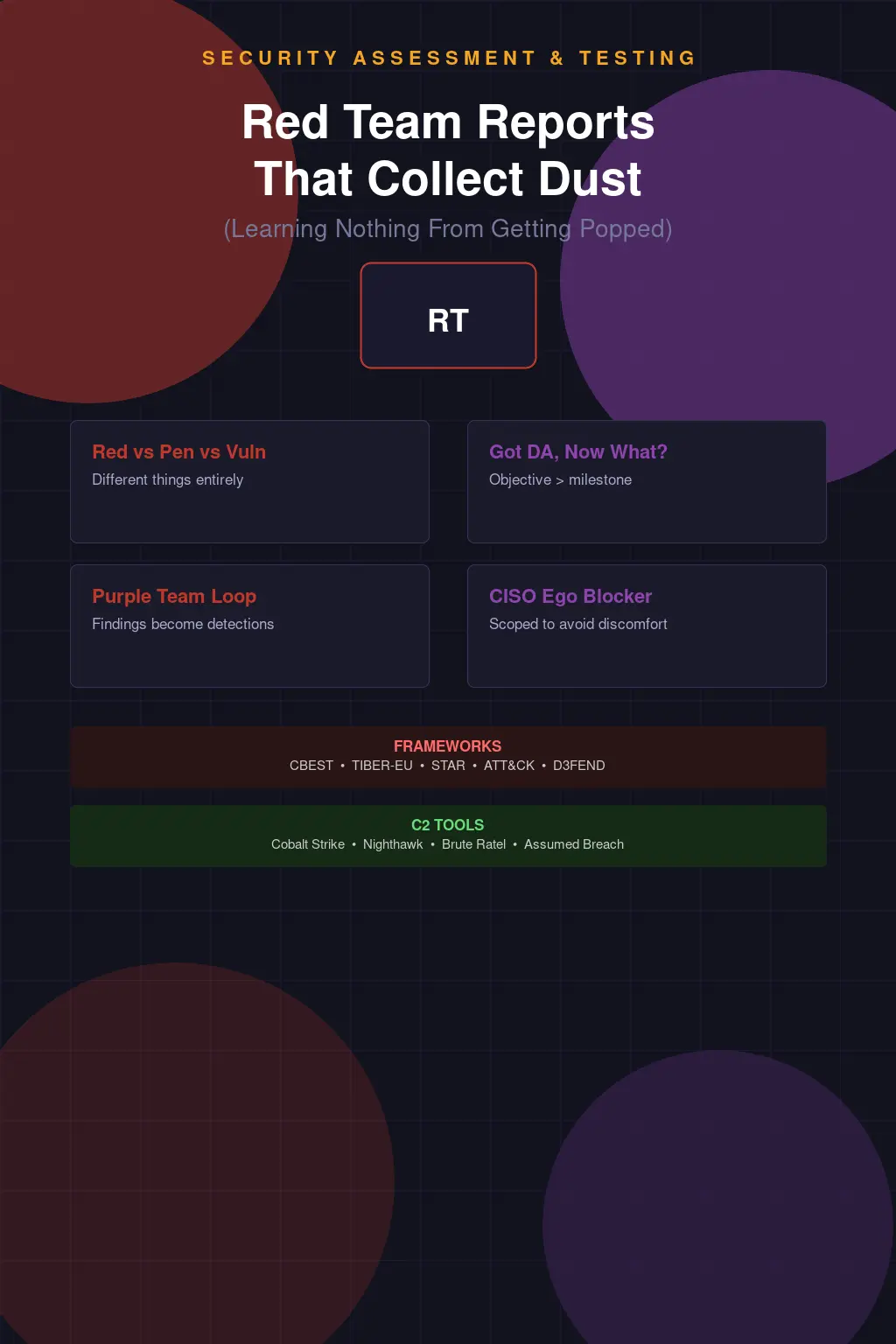
Nobody reads the report. That's the problem.
You hired a red team. They spent four to six weeks inside your environment, pivoted through three network segments, dumped credentials from your PAM solution, and exfiltrated a simulated dataset from the finance share. The operator wrote a forty-page report with MITRE ATT&CK technique IDs, Cobalt Strike beacon configs, and timestamped lateral movement chains. Your CISO said "great work" in the debrief. The report went into SharePoint. Three months later, the same lateral movement path still works.
This is not a hypothetical. It happens constantly, and the red team industry has collectively decided to look the other way because the money is in the engagement, not the remediation. You pay for the attack simulation. You don't pay for organizational change. And organizational change is the only thing that actually matters.
First, get the vocabulary right — because most organizations haven't
A vulnerability assessment is automated scanning with a human review layer. Nessus runs, someone triages the output, you get a list of CVEs sorted by CVSS score. That's it. It tells you what's theoretically exploitable, not what's actually reachable or what an adversary would chain together.
A penetration test has scope, objectives, and usually a defined methodology — PTES, OWASP, whatever your compliance framework demands. The tester finds a path, demonstrates impact, stops. It's meant to answer "can someone get in?" The answer is almost always yes, and the report tells you how.
A red team engagement is something different in kind, not just degree. The goal is not to find every vulnerability. The goal is to emulate a specific threat actor — their tools, their tradecraft, their objectives — and measure whether your people, processes, and technology detect and respond to that actor. The finding is not "you have an unpatched RDP server." The finding is "your SOC did not generate a single alert during fourteen days of active operations that included four compromised endpoints, two domain privilege escalations, and lateral movement to your backup infrastructure."
These are not the same thing. Treating them as interchangeable is how you end up spending $150,000 on an engagement and learning nothing operationally useful about your detection capability.
The "we got DA" antipattern is killing the value of your engagements
There's a lazy endpoint that a lot of red team engagements quietly default to: get domain admin, take a screenshot of the domain controllers list, write it up, call it done. Objective achieved. Everyone goes home.
I've seen statements of work that literally define success as "achieve Domain Admin privileges." That's not an objective. That's a technical milestone. The objective is what a real adversary does after they have DA — and whether your organization notices, responds, and recovers. Stopping at DA is like a fire drill that ends when someone pulls the alarm, without checking if anyone actually evacuated.
The frameworks that get this right define objectives in business impact terms. CBEST, the Bank of England's framework for testing financial sector firms, and TIBER-EU — the ECB's European equivalent — both require threat intelligence-led scenarios built around what a named threat actor category would actually want from your specific organization. Not generic "lateral movement to DC," but "access to SWIFT messaging infrastructure" or "exfiltration of M&A deal data." The scenario drives the test, and the test drives whether your controls are fit for the threat, not fit for a checkbox.
STAR (Systematic, Threat-based, and Adaptive Red teaming), used in the financial services sector, takes this further by building in continuous improvement cycles. The point is that the engagement is a data collection exercise for your defense program, not a one-time proof-of-concept that you were hackable — which, again, you already knew.
Assumed breach is where you actually learn something
Full-scope engagements — phishing, vishing, physical, external perimeter, internal pivot — are expensive and produce a wide surface of findings. They're good for certain things. But if your organization has never run an assumed breach scenario, you're skipping the exercise that tells you the most about your actual resilience.
Assumed breach means the red team starts with a foothold. A workstation already compromised. A set of low-privilege credentials. The perimeter bypass is assumed to have happened — because in most real incidents, it already has before anyone notices. The question isn't "can they get in" but "what happens next, and do you see it?"
I worked with a team that ran an assumed breach against a mid-size financial services firm. The operator dropped a Nighthawk implant on an agreed endpoint — Nighthawk being one of the post-Cobalt Strike commercial C2 frameworks that's harder to detect than CS by default, with better OPSEC defaults out of the box. That implant ran for eleven days before the engagement was over. The SOC never flagged it. Not because the EDR didn't have coverage — it did, and it was tuned — but because no one was hunting. The alerts existed in the SIEM. Nobody was looking at process injection events on workstations. The data was there. The workflow to act on it wasn't.
That's the finding. Not "your EDR missed a Nighthawk implant." The finding is "your SOC has no proactive hunting cadence, and your detection capability is entirely reactive to automated alert thresholds that an operator with decent OPSEC can stay below." That's a program-level finding. It changes headcount conversations, tooling conversations, training budgets. A pentest finding about an unpatched service changes a patch ticket.
MITRE ATT&CK mapping that actually means something
Every red team report now includes ATT&CK technique IDs. T1055 for process injection, T1078 for valid accounts, T1003 for OS credential dumping — the table is in the appendix, color-coded, looks great in the executive presentation. And then nothing happens with it.
ATT&CK is useful precisely because it gives you a shared language between offensive and defensive teams. If a red team operator used T1548.002 — Abuse Elevation Control Mechanism: Bypass User Account Control — your defensive team should be able to pull that technique, look at their detection coverage, and ask: do we have a detection rule for this? Does it fire? Did it fire during the engagement? If not, why not?
That's the purple team workflow. Not "red team attacks, blue team defends, we score it." Purple team is the structured exercise where you run a technique, check whether it generated the expected telemetry, tune the detection if it didn't, run it again. It's iterative. It's slow. It's the only way your ATT&CK mappings turn into detection rules instead of PowerPoint slides.
The D3FEND matrix is the counterpart — mapping defensive techniques to the offensive ones in ATT&CK. In theory, your detection engineering team should be able to take every technique from a red team report and trace it through D3FEND to understand what defensive coverage exists. In practice, most organizations don't have detection engineers. They have SIEM admins who inherited a thousand rules they didn't write and don't understand. The red team findings sit in a report. The SIEM rules don't change. The next red team finds the same gaps.
The CISO ego problem is real and nobody talks about it
"We don't need a red team. We have CrowdStrike."
I have heard this. Multiple times. From people who run security programs at organizations large enough to know better. The logic goes: we have EDR, we have a SIEM, we have a SOC (outsourced, three analysts, follows a runbook). We're covered. A red team would just embarrass us and create board-level anxiety.
The last part is what's actually happening. Red team engagements, when they go badly — meaning when the red team succeeds, which is most of the time — create uncomfortable conversations about whether the current security program is adequate. They produce evidence that the controls the CISO has been reporting as effective are not effective against a motivated adversary. That's politically uncomfortable. Especially when the CISO's annual performance review is tied to "no major incidents" rather than "measurable improvement in detection capability."
So engagements get scoped down. The red team can't touch production. Can't touch the PAM. Can't emulate certain threat actors because leadership is "concerned about operational impact." The engagement becomes a staged performance with guardrails that a real attacker wouldn't respect, and the findings are predictable enough that nothing has to change. The report collects dust. The CISO presents a slide about the engagement at the next board meeting. Everyone feels like something was accomplished.
The deconfliction and safety argument is legitimate, to be clear. Red teams hitting production environments without proper deconfliction can cause real outages. Brute Ratel C4 running on a production domain controller during peak business hours is not a smart call. But there's a difference between reasonable operational safety and using safety as a pretext to avoid learning anything uncomfortable. The former requires thoughtful scoping. The latter is organizational self-deception with a project plan attached.
What it actually means when the SOC doesn't detect you
Here's the thing about a SOC that never detected the red team: it's not necessarily evidence of a bad SOC. It might be. But it might also be evidence of exactly what an objective-based engagement is supposed to surface — a gap between the threat model you've been defending against and the threat actor you actually face.
Most SOC detection logic is built around known-bad indicators. Hashes, IPs, domains, YARA rules for known malware families. That works against commodity threats — ransomware affiliates running off-the-shelf tooling, script kiddies, low-sophistication phishing campaigns. A red team operator using a custom C2 with a legitimate-looking domain, sleeping their beacon for four hours between callbacks, and running everything in memory without touching disk is going to evade indicator-based detection reliably. That's not because your SOC is incompetent. It's because indicator-based detection was never going to catch this class of threat.
Behavioral detection is harder to build, harder to tune, and generates more noise. It requires analysts who can triage ambiguous alerts, not just run a playbook. It requires hunting — proactive queries against endpoint telemetry looking for anomalous patterns, not waiting for an alert to fire. Organizations that haven't invested in that capability will fail to detect a red team operating with reasonable OPSEC, and the red team report should say that clearly: "your current detection capability is insufficient against threat actors in X category because Y."
The report is the beginning, not the deliverable. The organizations that actually improve treat the report as a starting point for a purple team exercise — validate detections, test rules written in response to findings, and confirm that the specific techniques used now generate appropriate alerts. That's the loop that matters. Everything else is just an expensive way to generate a document nobody reads.