The Bug Bounty Illusion
Every few months, some VP of Security announces their shiny new bug bounty program with the energy of someone who just discovered that crowdsourcing security is a thing. The press release writes itself: "We take security seriously. We're inviting the global security research community to help us protect our customers." What they don't say is that they allocated exactly zero additional headcount to triage the incoming reports, set their critical payout at $200, and copy-pasted their scope definition from a competitor's HackerOne page without reading it. Eighteen months later, their triage queue has 400 unreviewed submissions, three researchers have gone public with vulnerabilities after being ghosted for six months, and someone on their bug bounty platform is getting paid $50 for a blind SQL injection that hits their primary customer database.
This is not a bug bounty success story. This is what most bug bounty programs actually look like. And the security industry's collective reluctance to say this out loud is part of the problem.
The Pentest Replacement Antipattern
There's a specific failure mode I've watched play out at company after company, and it starts in a budget meeting. Someone asks whether the security team needs a penetration test this year. The number comes back — call it $40,000 to $80,000 for a scoped engagement with a competent firm — and someone at the table says, "Why don't we just launch a bug bounty? We only pay for results." The room nods. The CFO loves it. The CISO, who should know better, sometimes goes along with it because at least it's something.
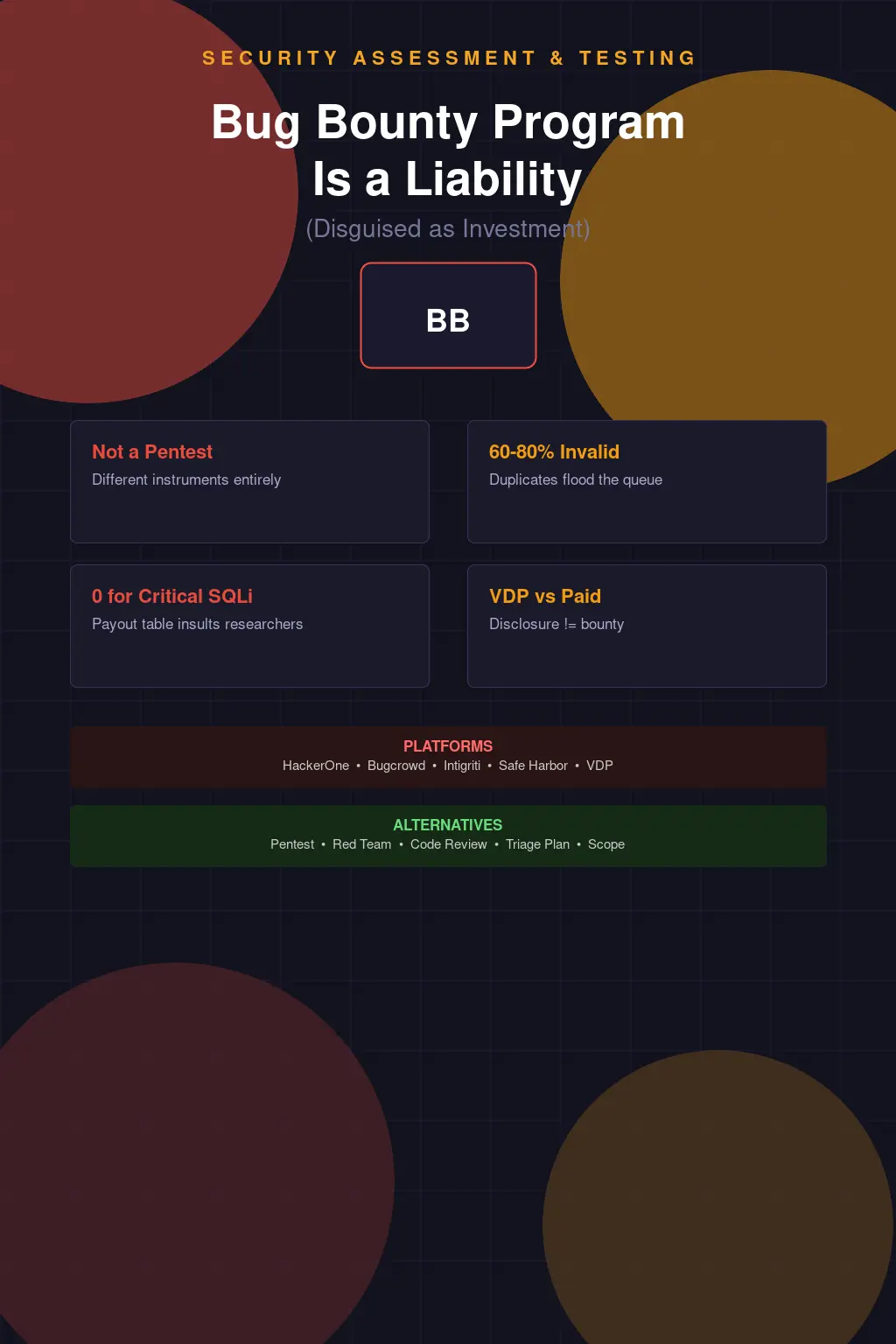
Here's the fundamental misunderstanding embedded in that logic. A penetration test is a time-boxed, scoped, adversarial exercise where trained professionals with full context attack your systems methodically, report every finding in a structured deliverable, and leave you with a remediation roadmap. You know when it starts. You know when it ends. You know what was tested. A bug bounty is a continuous, unstructured, researcher-dependent process where strangers with unknown skill levels poke at whatever surfaces they feel like, whenever they feel like it, with no obligation to be thorough, no guarantee of coverage, and no structured reporting. These are not equivalent instruments. Treating them as substitutes reveals a fundamental misunderstanding of what each one is for.
The "pay for results" logic also breaks down under scrutiny. A skilled penetration tester who finds nothing billable still delivered value: you now have evidence that a competent attacker couldn't find a critical flaw in your authentication flow. A bug bounty program where researchers don't find anything in your API gateway tells you almost nothing, because you don't know if researchers even looked at your API gateway, or if the ones who looked were junior researchers submitting information disclosure reports hoping for a quick $50.
Platform Economics Nobody Talks About Honestly
Let's talk about HackerOne, Bugcrowd, and Intigriti, because the platform conversation gets weirdly religious and almost nobody discusses the actual economics clearly.
HackerOne is the 800-pound gorilla. It has the largest researcher pool, the most name-brand programs, and the longest institutional history. It also charges platform fees that eat into your budget in ways that are not always obvious when you're signing the initial contract. Their managed triage offering sounds appealing until you realize you're paying for triage staff who are doing first-pass filtering and may or may not have deep familiarity with your specific technology stack. The researchers on the platform skew toward web application vulnerabilities — XSS, IDOR, CSRF, SQL injection, business logic flaws — which makes sense given where the payout density is. If your attack surface is heavily network-based, or involves embedded systems, or proprietary protocols, your HackerOne program is probably going to underperform your expectations regardless of your payout table.
Bugcrowd positions itself as more enterprise-friendly and has historically done more with managed security services wrapping the platform. Their CrowdMatch technology for routing reports to researchers with relevant expertise is genuinely useful when it works. But the same structural problems exist: you're still dependent on the program attracting researchers who are motivated by your specific payout levels and interested in your particular technology surface.
Intigriti has grown significantly in the European market and has some structural advantages for organizations with GDPR considerations and researchers who prefer European legal jurisdictions. They've also been more aggressive about researcher experience improvements, which matters more than people think.
Here's what all three platforms have in common: they're businesses that make money when your program runs and pays out. They are structurally incentivized to help you launch a program. They are not structurally incentivized to tell you that you shouldn't launch one yet, that your scope is too broad, that your triage capacity is inadequate, or that your payout table is going to attract volume without quality.
The Duplicate and Invalid Report Economics
Nobody tells you, before you launch, what the actual composition of your incoming report queue is going to look like. Programs run by organizations with significant public web presence routinely see 60 to 80 percent of incoming reports as either duplicates, out-of-scope submissions, or invalid findings. Automated scanner output dressed up as a human-written report. SPF record issues submitted as critical vulnerabilities. Missing security headers on marketing pages. Rate limiting concerns submitted without any evidence of exploitability. Missing HttpOnly flags on non-sensitive cookies. The same clickjacking report submitted by twelve different researchers who found it via automated tooling.
Each one of those reports requires a human to read, evaluate, and respond to. If you're running a managed triage service, each one costs you money or time or both. If you're running your own triage with internal staff, each one is pulling engineers away from their actual work. Triage team burnout is real and it's underreported. The people doing bug bounty triage are typically not senior security engineers — they're often more junior staff or dedicated triage contractors. They're reading the same categories of invalid reports every day, writing polite rejection messages, managing researcher frustration, and occasionally flagging something genuinely interesting to a senior engineer who may or may not prioritize it.
The $50 Critical Finding Problem
I want to dwell on the payout issue because it connects to almost everything else that goes wrong. There is a category of company that launches a bug bounty program with payout tiers that were never calibrated to actual market rates. Critical vulnerabilities paying $200. High severity at $100. Medium findings at $50. These numbers exist because someone made them up based on what they felt comfortable approving, not based on what researchers actually expect or what the vulnerability is worth.
A researcher who finds a SQL injection in your primary customer database — blind, out-of-band, against a production system — has just spent potentially dozens of hours understanding your application, mapping your attack surface, developing a proof of concept, and writing a clear report. If you pay them $50 for that, you have not made a friend. You have made an enemy who now has a clear picture of a critical vulnerability in your infrastructure and a completely legitimate grievance about being disrespected.
The flip side is organizations that set aggressive payout tables they can't actually sustain. If you're offering $10,000 for a critical RCE and your program is well-known, you will get researchers dedicating serious time. If you then quietly lower your payout tiers because your security budget got cut, you've just poisoned your relationship with every researcher who spent time on your program expecting the original terms.
VDP Versus Paid Bounty: An Underappreciated Distinction
One of the most useful things a lot of organizations could do is separate their Vulnerability Disclosure Policy from a paid bug bounty program. A VDP is a legal and procedural mechanism: it tells researchers how to report vulnerabilities to you, gives them a communication channel, and ideally provides safe harbor against legal action if they discover something while doing good-faith security research. A paid bounty is an incentive program designed to attract motivated researchers.
These are not the same thing and they don't require each other. You can have a robust VDP with clear safe harbor language, a defined response timeline, and genuine commitment to communication without paying researchers anything. Many organizations should probably do exactly this. A VDP with no budget is infinitely better than no VDP, because a VDP gives researchers a path that doesn't end in a cease-and-desist letter.
The safe harbor question matters more than most organizations realize. If your VDP doesn't have clear language protecting researchers from legal action when they find something while staying within your defined scope, you're exposing researchers to CFAA liability in the US and equivalent laws in other jurisdictions.
Google and Microsoft Are Not a Template for You
Every conversation about bug bounty programs eventually invokes Google's or Microsoft's program as a model. Google has paid out tens of millions of dollars in researcher rewards. These organizations have dedicated vulnerability research teams staffed by some of the best security engineers in the world. They have triage infrastructure built over decades. They have legal teams that have thought deeply about safe harbor. They have brand recognition that attracts top-tier researchers.
When a 200-person SaaS company looks at Google's bug bounty program and decides to model theirs after it, they are borrowing a framework designed for an organization with ten thousand security-adjacent engineers and applying it to a team of three. Reports pile up. Response times balloon. Findings get marked "informative" — that wonderfully bureaucratic term for "we acknowledge this exists but we're not paying for it and we're not committing to fixing it." The abuse of the informative closure to avoid payouts while still technically responding to reports is one of the things that has genuinely eroded researcher trust in the broader bug bounty ecosystem.
When Bug Bounty Actually Makes Sense
A bug bounty program is appropriate when you have already done the foundational work: you've run penetration tests, you've remediated the findings, you have a mature vulnerability management process, you have triage capacity, and you're looking for continuous coverage on a large, changing attack surface that a periodic pentest can't keep up with. Your payout table is calibrated to actual market rates. Your scope is precisely defined. You have a legal team that has actually reviewed your safe harbor language.
If you're missing two or more of those conditions, you're probably not ready for a paid bounty program. A VDP, yes. A paid bounty that you're actually prepared to run well — probably not yet. The next time someone in a budget meeting suggests launching a bug bounty instead of buying a penetration test, the right response is to ask them what the triage plan is. Ask them who owns the researcher communication process. Ask them what happens when a researcher submits a valid critical finding at 2am on a Friday. Watch how many of those questions get blank stares, and then make your call.