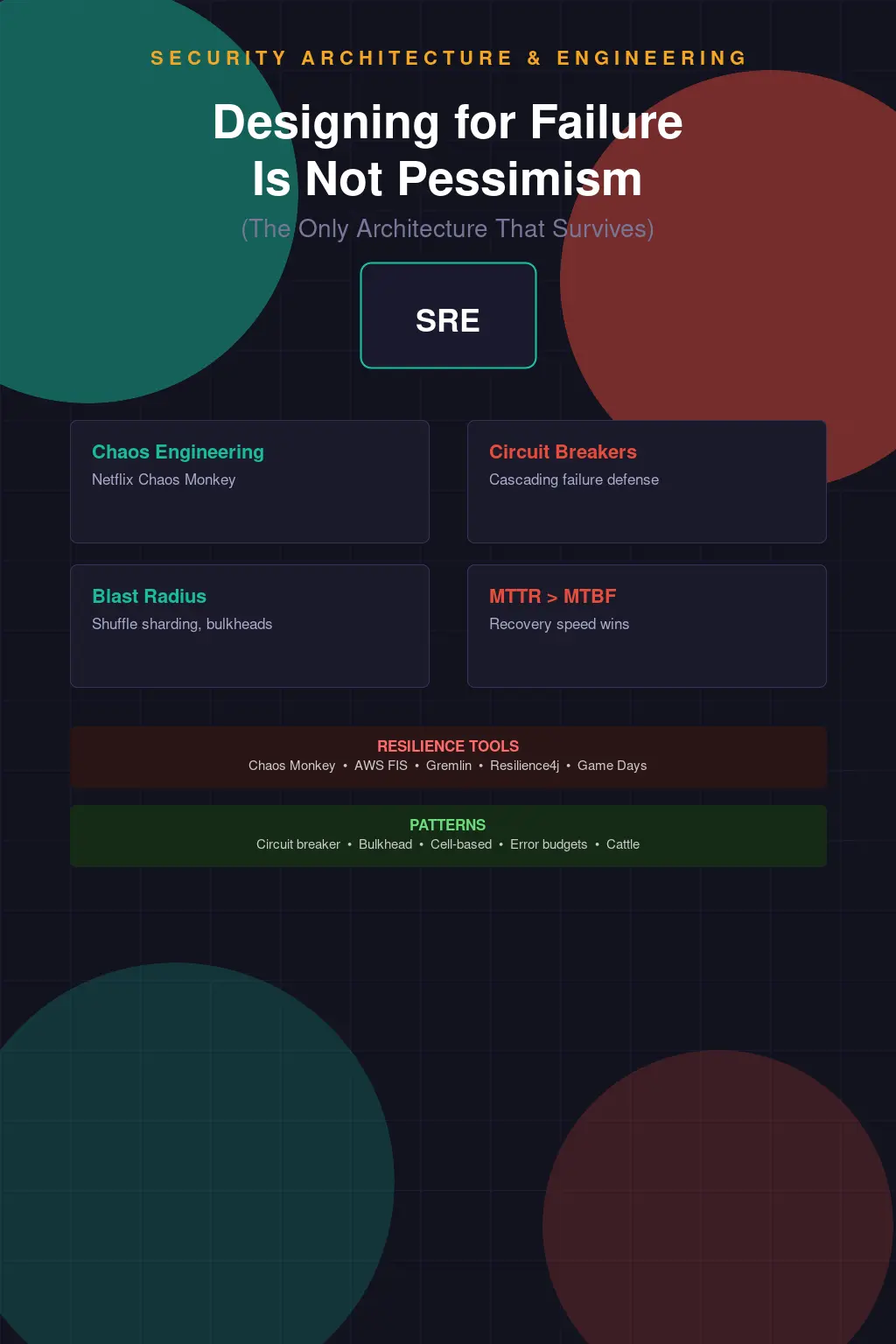
Stop Building for the World Where Everything Works
Here's the thing nobody wants to say out loud in the architecture review: your system is going to fail. Not might. Not "in rare edge cases." It's going to fail, and the only question worth asking is whether you designed for that moment or whether you're going to be scrambling at 2 AM reading runbooks that haven't been touched since the last person who understood them left the company.
I've sat in too many design sessions where the entire conversation was about the happy path. How data flows when everything's healthy. How authentication works when the IdP is up. How the payment processor responds when it feels like responding. The failure modes get a single slide at the end — usually something vague about "retry logic" and "monitoring alerts" — and then we move on. That's not architecture. That's wishful thinking with a diagram.
Resilience engineering isn't pessimism. It's the most rigorous form of honesty you can apply to a system. You're forcing yourself to confront what's actually true: dependencies fail, networks partition, disks fill up, operators make mistakes, and adversaries exist specifically to exploit the gap between your assumptions and reality.
The AWS us-east-1 Incident Taught Everyone Something — Most People Learned the Wrong Lesson
December 7, 2021. AWS us-east-1 goes down in a way that takes out not just EC2 and RDS but the monitoring and status dashboard used to communicate the outage. The irony was almost poetic — you couldn't see how bad it was because the tooling used to tell you how bad it was lived in the same region that was on fire.
What was interesting wasn't the outage itself. Large-scale distributed systems fail. That's not news. What was interesting was sorting the organizations into two buckets: those who experienced an incident, and those who experienced an existential crisis.
The ones who survived with minimal impact weren't the ones with the most sophisticated architectures on paper. They were the ones who had actually tested their multi-region failover. Who had done the uncomfortable work of proving, in a live environment, that their Route 53 health checks would flip correctly, that their RDS read replicas in us-west-2 could be promoted in under fifteen minutes, and that their application actually functioned against the standby database rather than just assuming it would.
The ones who didn't survive with their SLAs intact had documentation that said "multi-region capable." Documentation is not a substitute for a tested failure path. This is the central failure mode of the industry — we mistake designed-for for tested-for.
Chaos Engineering Is the Only Honest Load Test
Netflix's Chaos Monkey — the original, built in 2011 to randomly terminate production instances — was controversial internally when it launched. The engineering culture at the time, like most engineering cultures, was oriented around keeping things up. The instinct is to protect uptime, not intentionally destroy it. But the Chaos Monkey team's argument was airtight: if your system can't handle an instance dying, you're going to find out eventually. Better to find out on a Tuesday afternoon than during peak traffic on a Friday night.
That philosophy matured into the Simian Army and eventually into a broader discipline. AWS Fault Injection Simulator brought this into the enterprise space, letting you run controlled fault injection experiments against EC2, ECS, EKS, RDS, and a growing list of services. Gremlin commercialized it further, adding CPU exhaustion, memory pressure, network latency injection, and packet loss as first-class experiment primitives. The tooling is no longer the hard part.
The hard part is organizational. Running chaos experiments in production requires that engineering and security leadership actually believe the system should be tested this way. It requires an error budget — the SRE concept where you accept that a certain amount of downtime is permissible, and you use that budget deliberately to learn rather than burning it accidentally to discover. Google's SRE book frames error budgets as a negotiation between development velocity and reliability. I'd extend that: error budgets are a security tool. They tell you exactly how much room you have before your resilience assumptions need to be re-examined.
If you have a 99.9% monthly SLA and you've burned 40 minutes of your 43-minute error budget on a chaos experiment that revealed your circuit breaker configuration was wrong, that's a win. You found the failure mode for the cost of 40 minutes of controlled degradation rather than a random 4-hour outage during a board demo.
Circuit Breakers Are Not Optional, They're Table Stakes
Michael Nygard's Release It! — if you haven't read it, stop what you're doing — introduced the circuit breaker pattern as the primary defense against cascading failure. The premise is simple: if a downstream dependency is failing, stop hammering it with requests. Open the circuit, return a fallback, and check periodically whether the dependency has recovered. It's the difference between a contained incident and a full cascade where your healthy services are dragged down by the sick ones.
Hystrix, Netflix's implementation, was the reference for years before going into maintenance mode. Resilience4j is the current Java-ecosystem answer, and it's excellent. But the implementation detail matters less than understanding why you need it architecturally.
Here's an anecdote. A financial services client had a payment processing flow that called an external fraud scoring API. The fraud API had a mean response time of 80ms under normal conditions. During a peak traffic event, the fraud provider's infrastructure started degrading — response times climbed to 8 seconds, then 12, then 30. The client's payment service had no circuit breaker. Every payment request was holding a thread for 30 seconds waiting for a fraud score that wasn't coming. Thread pool exhausted. Connection pool exhausted. The payment service — which was otherwise completely healthy — fell over because it had a hard dependency on a service it had no way to isolate from.
The fix wasn't complex. A circuit breaker with a 2-second timeout threshold, configured to open after 50% failure rate over a 10-second window, and a fallback that allowed transactions below a certain dollar threshold to proceed with asynchronous fraud scoring. But the conversation to get there was painful because it required product and security stakeholders to agree that a degraded-but-functional payment flow was acceptable during a dependency outage. That's a policy decision that should be made on a Monday morning, not during an incident at 11 PM.
Blast Radius Is an Architecture Input, Not an Afterthought
Blast radius containment needs to be treated the same way you treat threat modeling — as a first-class design constraint, not something you retrofit. The question isn't "what happens when this works?" It's "what's the worst-case impact when this component fails, and is that acceptable?"
AWS's shuffle sharding is one of the more elegant implementations of this idea I've seen in production infrastructure. The concept, detailed in Colm MacCárthaigh's writing on the subject, is that you don't assign customers to fixed shards. Instead, you give each customer a unique combination of worker nodes, and the overlap between any two customers' sets of workers is small. If one customer's traffic is pathological — maybe it's being used as a DDoS vector, maybe it's a buggy client hammering the API — the blast radius is limited to the small number of shared workers, not the entire fleet.
The bulkhead pattern, borrowed from shipbuilding, is the same idea applied at the service level. Isolate thread pools and connection pools by caller. If your mobile API clients are in one bulkhead and your internal service clients are in another, a mobile-side traffic surge doesn't exhaust the resources your critical internal services depend on. This is security architecture as much as it is reliability architecture — you're limiting the propagation of failure the same way you'd limit the propagation of compromise.
Cell-based architecture takes this further. Rather than a single global deployment where all customers share infrastructure, you partition into cells — isolated stacks that serve a subset of customers. A failure in one cell, a misconfiguration, a bad deployment, a compromised dependency — it affects that cell's customers and no one else. Amazon's retail infrastructure has been operating on cell-based principles for years. It's expensive to build. It's worth it.
Five Nines Means Nothing If You've Never Pulled the Plug
The most dangerous SLA is one that's been calculated theoretically and never validated empirically. I've seen organizations run on 99.999% availability targets that had database failover procedures documented but never executed in a real environment. The documentation said the failover would complete in under a minute. When they finally tested it — during a game day, thankfully, not a real incident — it took eleven minutes because the application servers had the primary's IP hardcoded in a config file that nobody had updated in three years.
MTBF — mean time between failures — is the metric organizations tend to optimize for because it feels good. Less frequent failures means a more reliable system, right? The problem is that in a sufficiently complex distributed system, something is always failing somewhere. Individual component MTBF keeps climbing while system-level failure modes multiply. MTTR — mean time to recover — is the metric that actually determines your operational reality. A system that fails rarely but takes four hours to recover when it does is categorically worse than a system that fails more often but recovers in minutes.
This is where the "cattle not pets" infrastructure philosophy intersects with security. Immutable infrastructure — systems that are never modified in place, only replaced — means your recovery path is always "terminate and rebuild from a known-good image." There's no configuration drift. There's no SSH session six months ago where someone changed a kernel parameter and nobody documented it. The blast radius of a compromise is bounded by what an attacker can do before the instance is rotated. Your MTTR is bounded by how fast you can provision from infrastructure-as-code, which is bounded by how invested you are in actually maintaining that code.
Game Days vs. Tabletops: One of These Actually Finds Problems
Tabletop exercises have value. I'm not going to sit here and say they don't. But they test your knowledge of your system against your mental model of your system. The dangerous assumption is that your mental model is accurate.
Game days — where you run actual failure scenarios against production or a production-equivalent environment, with real engineers responding in real time — find the gap between the mental model and reality. They find the database failover that takes eleven minutes instead of one. They find the runbook that references a service that was deprecated eighteen months ago. They find the on-call engineer who has never actually executed the incident response procedure and is learning it for the first time while an outage is in progress.
The resistance to game days is always the same: "we can't take the risk of introducing failure intentionally." This argument is backwards. You are already accepting the risk of failure — you're just ceding control of when and how it happens. A game day is you choosing the timing, the scope, and the conditions. An unplanned outage is the universe choosing for you, and the universe doesn't care about your release schedule or your customer commitments.
From a security posture standpoint, the organizations that run regular game days — quarterly at minimum — develop something that can't be bought: operational muscle memory. When a real incident happens, the team isn't reading a runbook for the first time. They've been in this scenario. The cognitive load is lower, the decisions are faster, and the blast radius of the incident shrinks because the response is competent.
Designing for failure isn't a concession that your systems are bad. It's a commitment to honesty about what distributed systems are. It's the acknowledgment that resilience is an engineering discipline, not a property that emerges from good intentions and sufficiently detailed documentation. The organizations that survive the next us-east-1 won't be the ones with the best architecture diagrams. They'll be the ones who pulled the plug, watched what happened, fixed what broke, and did it again.