Shift Left Became Shift Blame — Why DevSecOps Failed Without Security Engineers
Somewhere around 2018, "shift left" became the security industry's answer to everything. Developers move too fast? Shift left. Vulnerabilities reaching production? Shift left. Security reviews taking too long? Shift left. The pitch was elegant: if you find security issues earlier in the development lifecycle — in the IDE, in the PR, in CI — you find them cheaper and faster than if you find them in production. That's true. It's also true that "shift left" became shorthand for "make the security problem the developer's problem," without giving developers the training, tooling, or organizational support to actually handle that problem. The result is that a lot of organizations have shipped an enormous amount of vulnerability noise to development teams and called it a DevSecOps program.
I've sat in sprint retrospectives where developers spent 20 minutes explaining why they closed a Snyk finding as "won't fix" — not because the finding was wrong, but because the developer had no idea whether it was actually exploitable in their context, the security team wasn't available to advise, and they had a feature deadline. That's not a developer failing at security. That's a program failure. You gave them a tool that produces findings, no context for triaging those findings, no support system, and competing incentives. Of course they closed it.
The Staffing Math Nobody Wants to Say Out Loud
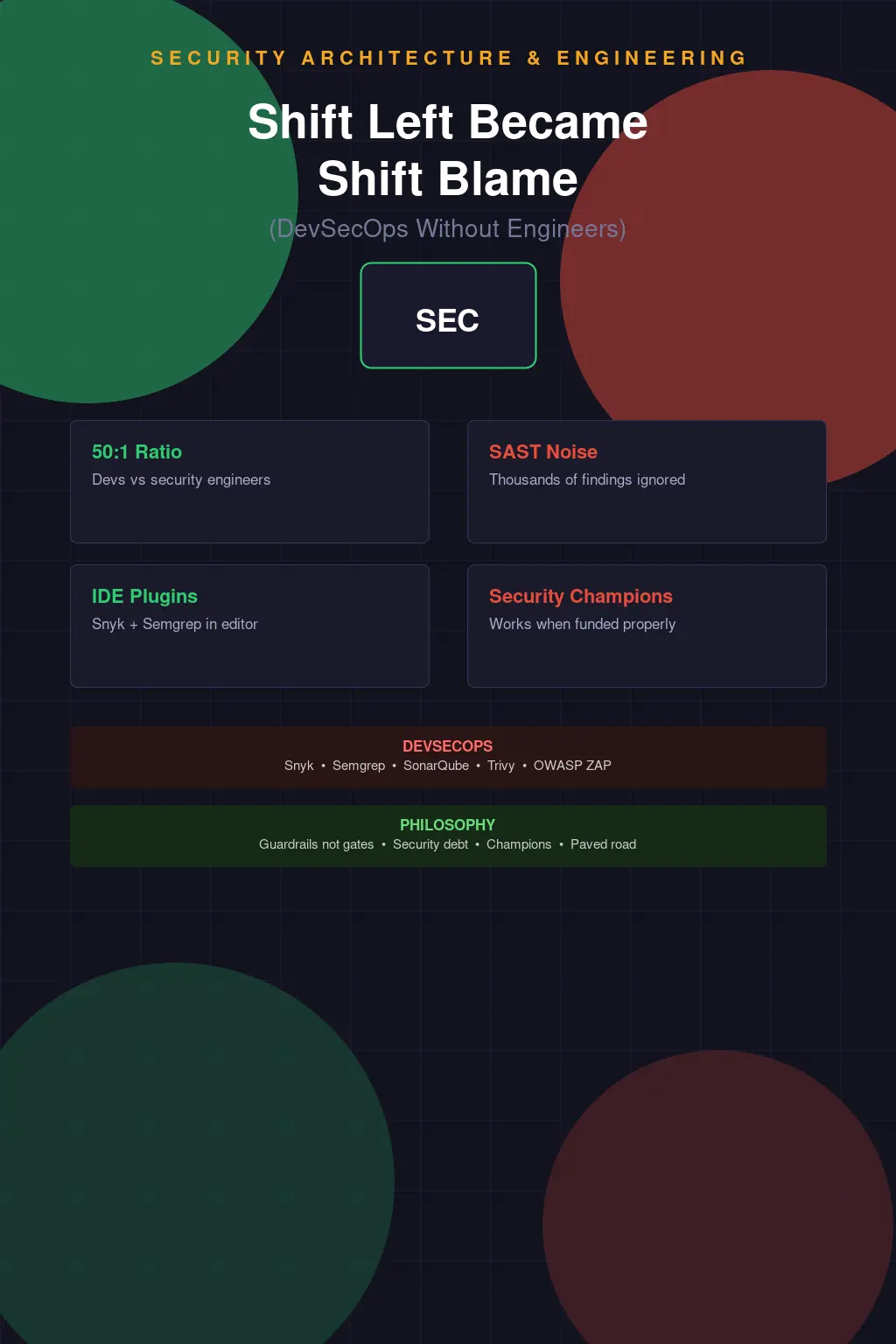
The 10:1 developer-to-security-engineer ratio is often cited as a rough industry benchmark — for every ten developers, you should have roughly one security engineer available to support them. Most organizations aren't close. I regularly see security teams of three people supporting engineering organizations of 150+ developers. That's a 50:1 ratio. At that staffing level, the security team cannot do meaningful application security review. They cannot triage every finding that tools surface. They cannot be available to answer developer questions. They cannot review every PR. They are structurally incapable of doing the job that the org expects them to do.
The shift-left response to this staffing reality was to automate the security engineer out of the loop — let the tools do the scanning, let the developers do the triage, let the gates make the decisions. And automation is the right direction. But automation is not a replacement for security expertise; it's a force multiplier for security expertise. When you remove the security expertise and keep only the automation, you end up with tools that produce findings nobody can evaluate and gates that either get disabled because they're too noisy or get bypassed because they block delivery. The automation without the expertise is worse than nothing, because it creates the appearance of a security program without the substance of one.
What SAST and DAST Actually Surface vs What They Claim
Static Application Security Testing tools — Semgrep, Checkmarx, SonarQube, CodeQL, Fortify — analyze your code without running it, looking for patterns that match known vulnerability classes. They're genuinely useful for finding certain categories of issues: SQL injection, hardcoded secrets, use of deprecated cryptographic functions, obvious XSS patterns, path traversal vulnerabilities in simple cases. They are genuinely terrible at finding logic vulnerabilities, business logic flaws, access control issues that depend on runtime context, and anything that requires understanding what the code is supposed to do rather than just what it does.
The false positive rate on most SAST tools is high enough to be operationally damaging. I've seen SonarQube configurations that produce 400+ findings per scan on a mature codebase — findings that have been there for months, that developers have stopped reading because the ratio of real issues to noise makes the list untriageable. When developers stop reading your security findings, your SAST tool isn't a security control. It's a compliance checkbox that produces log entries.
Dynamic Application Security Testing (DAST) has a different problem: it requires a running application, which usually means it can only run against staging environments, and it's slow. A full DAST scan takes hours. In an environment where CI/CD pipelines run on every PR and a developer might push ten commits in a day, a tool that takes hours to produce results doesn't fit the workflow. DAST gets pushed to a scheduled weekly job, which means it's not integrated with the development workflow in any meaningful way, which means findings surface days after the code was written, which means fixing them is context-switching overhead rather than natural part of development.
IDE Plugins: The Version of Shift Left That Actually Works
The shift-left tooling that genuinely changes developer behavior is the kind that lives in the developer's environment and gives feedback while they're writing the code, not after they've committed it. Snyk and Semgrep both have IDE integrations that surface findings inline, the same way a linter would surface a syntax error. The developer sees the issue while the context is fresh, can understand the feedback in the context of the code they just wrote, and can fix it before it ever becomes a PR comment or a CI failure.
This sounds like a small difference from finding the same issue in CI, but behaviorally it's enormous. A CI failure is a context switch: the developer has moved on to something else, they have to go back, they have to re-understand the code, and the failure feels like a blocker on their work. An IDE finding is part of the normal development flow: the developer sees it immediately, understands it, fixes it. The same finding, the same tooling — but the timing determines whether it's integrated into work or disruptive to work.
The catch is that IDE plugins only help if developers actually use them, which requires that the plugins are fast, that the signal-to-noise ratio is acceptable, and that developers trust the findings. If the plugin flags things developers know are false positives or understand are acceptable in their context, they'll turn it off. Tuning matters more than deployment.
Security Champions: The Program That Works and the One That Doesn't
Security champion programs have a wide variance in effectiveness, and the difference usually comes down to a single question: does being a security champion actually change anything about your job, or is it just a title?
The programs that work give security champions real authority and real support. They get dedicated time — not "fit it in around your normal work," but actual sprint capacity — to work on security improvements. They get training that makes them meaningfully more capable, not a one-time security awareness course. They have a direct line to the security team, which is responsive and helpful rather than a bottleneck. They have visibility into the security posture of their team and can influence it. The security champion role has teeth: they can block releases for security reasons, they can require fixes before merges, they can escalate to the security team and get action.
The programs that fail make security champion a ceremonial title. Engineers get added to a Slack channel, invited to a monthly meeting, given a badge in their email signature. Nobody's expectations change. There's no time allocated. There's no authority to make decisions. When security issues come up, the champion's role is to relay messages between the security team and their development team — a communication layer, not an empowered security decision-maker. These programs exist to allow the organization to say "we have security champions in every team" without requiring the investment that would make that actually mean something.
The Break-the-Build Debate and Why It's the Wrong Argument
Should security findings block CI pipelines? This argument consumes enormous amounts of energy in security and engineering organizations, and I think it's the wrong framing. "Break the build" treats security gates as binary — either the finding blocks the build or it doesn't — and that binary creates a political fight between security (who want blocking gates to force action) and engineering (who need to ship and can't have every scan failure become a blocker).
The better framing is: what's the cost of this finding and what's the right response mechanism? A hardcoded AWS secret key committed to the codebase? That should absolutely break the build, immediately, and also trigger an alert to rotate the credential. A medium-severity XSS finding in a component that doesn't handle user input in a security-relevant context? That should be tracked as a finding, triaged, and addressed in the normal workflow — but probably shouldn't block every other PR that touches that codebase while it's being evaluated.
The "guardrails not gates" philosophy is a more useful mental model. Guardrails guide behavior without creating hard stops for everything. A guardrail that flags all findings and routes high-severity ones to an automatic review process is more sustainable than a gate that fails any build with a finding above a certain severity threshold. The goal is to make secure behavior easier than insecure behavior — not to create friction that developers route around. And they will route around friction. I've watched engineers edit .semgrepignore files in production code to suppress legitimate findings because the CI gate was failing their build. That's not a security program. That's security theater with extra steps.
Security Debt Is Just Technical Debt in a Scary Mask
Organizations that manage technical debt well tend to manage security debt well, and the ones that struggle with one struggle with both. The same patterns apply: debt accumulates when the pressure to ship outweighs the incentive to maintain quality, it compounds over time as new code is built on top of insecure foundations, and it becomes genuinely expensive to remediate when it's finally addressed years later.
The organizational mistake I see most often is treating security debt as categorically different from technical debt — as something that belongs to the security team rather than to engineering. Engineering teams routinely allocate sprint capacity for technical debt remediation. It's normal and expected. Security debt remediation should be handled the same way: owned by the engineering team, allocated sprint capacity, prioritized alongside feature work. When security debt belongs only to the security team, it never gets allocated resources, it never gets fixed, and it grows until a breach makes it impossible to ignore.
The security team's role in DevSecOps isn't to own all the security work — it's to give engineering the context and tooling to own their own security posture. That means good documentation of findings in language developers understand. That means being available and responsive when developers have questions, not just when there's an incident. That means establishing clear criteria for what requires security review versus what's in-scope for a developer to handle independently. It means treating developers as capable adults who can handle security responsibilities if given appropriate support, rather than either ignoring them (the old model) or dumping undifferentiated tool output on them and calling it their problem (the failed shift-left model).
DevSecOps as a concept isn't wrong. The failure mode was treating it as a tooling problem when it's fundamentally a people-and-process problem. You can't automate your way to a security culture. You need security engineers embedded in the development process, with the relationships and credibility to influence how code gets written, and you need engineering leadership that treats security as an engineering quality concern rather than an external compliance requirement. That's a harder change than buying a tool. It's also the only change that actually works.